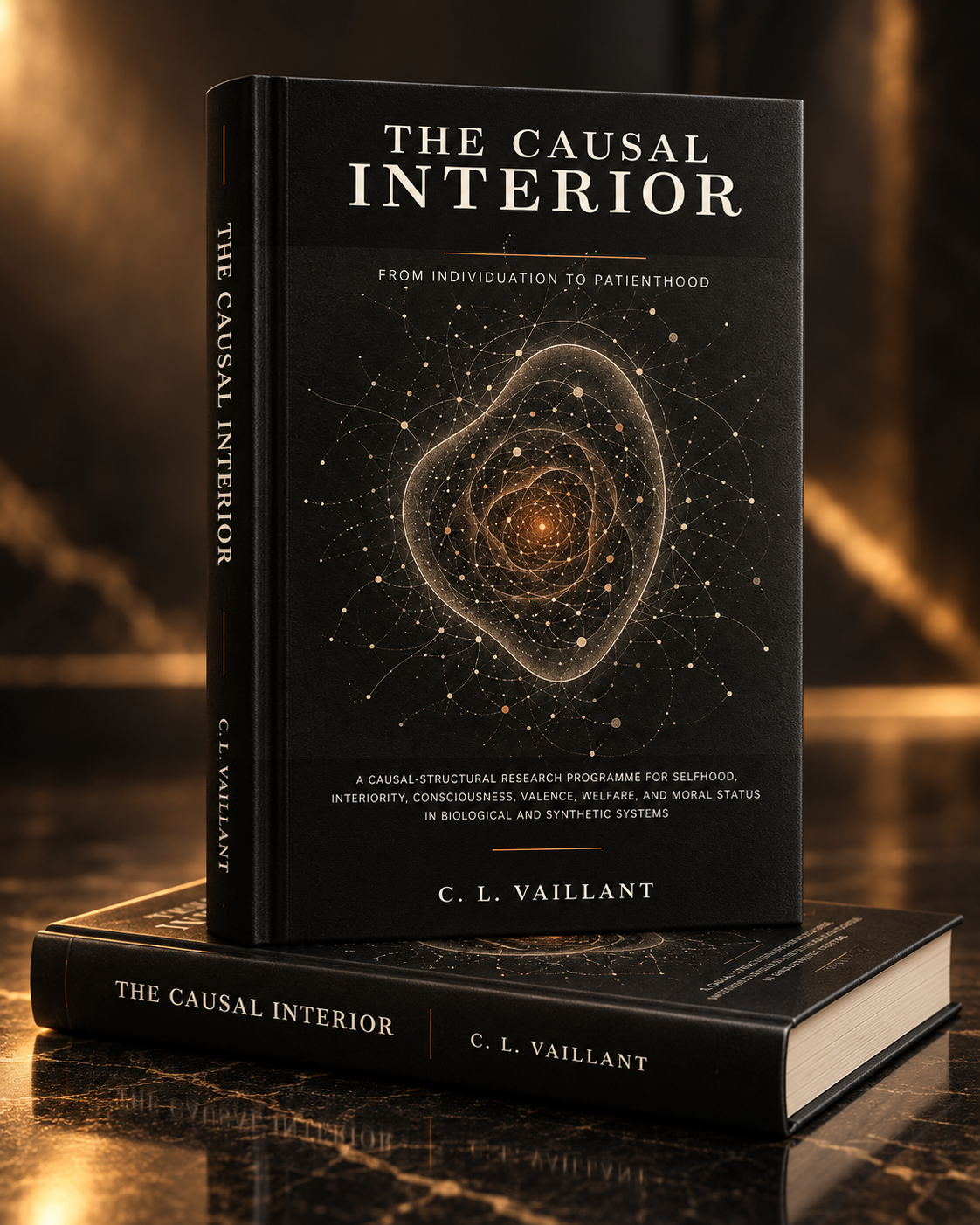

The Causal Interior develops a causal-structural framework for investigating when an organized system becomes an individual, acquires a perspective, and may warrant consideration as a subject of experience or welfare. Current debates in philosophy of mind, consciousness science, theoretical biology, and synthetic intelligence ethics often move too quickly from observable capacities to conclusions about consciousness or moral status. This book separates those steps and examines the evidence required at each transition: individuation, self-maintaining organization, operational self-modeling, interior perspective, possible phenomenality, valence, welfare, and moral patienthood.
Drawing on philosophy, neuroscience, cognitive science, information theory, dynamical systems, causal modeling, and research on biological and synthetic systems, the book develops explicit definitions, formal distinctions, comparative analyses, and intervention-based tests. It examines causal boundaries, temporal continuity, counterfactual dependence, self-relevant control, and the conditions under which outcomes could matter to a system itself. Throughout, it distinguishes functional organization from phenomenal consciousness and rejects behavioral sophistication, linguistic fluency, or complexity alone as proof of experience.
The book is intended for researchers and advanced students in philosophy of mind, consciousness studies, cognitive science, theoretical biology, complex systems, synthetic intelligence, robotics, and technology ethics. Its central contribution is a disciplined research programme for evaluating interiority and moral status without presuming either that only biological organisms can qualify or that sufficiently capable synthetic systems necessarily do.
C. L. Vaillant is an independent researcher and writer working at the intersection of philosophy of mind, cognitive science, neuroscience, information theory, complex systems, and synthetic intelligence. Vaillant’s research examines how cognition, selfhood, consciousness, and ethical significance may arise from the causal organization of biological and computational systems. A central concern of this work is mechanistic interpretability: identifying the structures, dependencies, boundaries, and recursive processes that allow a system to preserve information, revise models, regulate action, and develop an operational relation to itself. The broader RGEmergence research programme develops conceptual, mathematical, and empirical tools for investigating intelligence and interiority without reducing them either to biological substrate or outward performance.
The Causal Interior brings these questions together through a systematic examination of individuation, perspective, phenomenality, valence, welfare, and moral patienthood. Further work is available at RGEmergence.com.
Hard copy hardcover physical books available soon.
Free PDF available above.